The Bible furnishes ample evidence that at different periods in ancient Israel, three different festival calendars and different calendar systems were employed. The first of these may well be called the Canaanite Calendar… The second calendar, … is characterized by the fact that it refers to the months by number instead of by name, and so speaks of the first month, the second month, and the like. The third calendar used the Babylonian names of the months…
THE THREE CALENDARS OF ANCIENT ISRAEL
By JULIAN MORGENST
Understanding the history of the calendar and marking the changes along the way help to unravel the mystery and the apparent discrepancy between the modern Jewish calendar and that of the one presented in the Dead Sea Scrolls, and books such as Jubilees and Enoch. In our modern canon of scripture, the calendar and or a description of it is nearly nonexistent which only adds to the confusion and opens the door to a multitude of opinions, traditions, emotional investments, you name it. While attempting to work through the calendar I have encountered many variations of arguments and attempts to uphold one calendar over another, and they are nearly all based on little more than a preference and tradition. While we do have some names for the months in scripture it is not an exhaustive list. We can isolate the names of 8 out of the 12 months. Four of those names come from the ancient Canaanite Paleo and five are from the modern Hebrew. The first month Abib/Nisan is represented by both the ancient and modern. The remaining references as the quote above indicates are only given a number. On the surface that’s just about all we have in scripture. The problem is that only one calendar can be the true calendar, and honestly only one can truly be proven in scripture.
Babylonian vs the Modern Hebrew
Babylonian/Akkadian Calendar
- Nisānu – 𒌚𒁈
- Āru – 𒌚𒄞 – (“Month of the Blossoming'”)
- Simanu – 𒌚𒋞
- Dumuzu – 𒌚𒋗 – (“Month of Tammuz”)
- Abu – 𒌚𒉈
- Ulūlu – 𒌚𒆥
- Tišritum – 𒌚𒇯- (“Month of Beginning”)
- Samnu – 𒌚𒀳 – (“Month the Eighth”)
- Kislimu – 𒌚𒃶
- Ṭebētum – 𒌚𒀊 – (“muddy month”)
- Šabaṭu – 𒌚𒍩
- Addaru / Adār – 𒌚𒊺
- Addaru Arku – 𒌚𒋛𒀀𒊺
Modern Hebrew/Jewish Calendar
- Nisan – 7th month – Neh 2:1,
- Iyyar – 8th month
- Sivan – 9th month
- Tammuz – 10th month
- Av – 11th month
- Elul – 12th month – Neh 6:15
- Tishrei – 1st month
- Marcheshvan (aka Cheshvan) – 2nd month
- Kislev – 3rd Month – Neh 1:1, Zec 7:1
- Tevet – 4th month
- Shevat – 5th month – Zec 1:7
- Adar – 6th month – Ezra 6:15
- 2nd Adar
The Talmud records the tradition that the exiles, returning from Babylonian captivity, brought back with them the Babylonian month names. and when comparing the Modern Hebrew to the Babylonian names the connections are unmistakable. But the connections do not end there. Both of these calendars are lunar based and require a 13th intercalary month every 2-3 years to keep the calendars in line with the seasons. Being a lunar calendar, the first day of each month (beginning at sunset) began when a new crescent moon was first sighted. Today’s more modern Hillel Calendar does not use the sighted moon like the ancient version but rather uses the conjunction or dark moon and has been calculated rather than observed for quite some time. Also, the intercalation methods have been adjusted to more accurately align the years with the solar seasons. The big difference between the Hebrew and Babylonian civil calendars is in regard to the beginning of the year. The current Hebrew Hillel calendar begins its civil calendar on the 7th month, while the ancient Babylonian calendar began on the month Addaru which later became the 12th month. Like the biblical calendar, Addaru was also associated with the harvesting of Barley.
The Egyptian Connection
Some scholars theorize that the ancient Canaanite calendar may have started in the 7th month and the change between the Babylonian calendar and the Hebrew calendar was to rectify those differences upon their return from exile. However, all through scripture the numbering of the months never changes so there must have been a different reason for this change. I believe the original reason Yahuah had to remind the Israelites that the month Abib would be the beginning of the year for them, was most likely due to the fact that the Egyptian calendar began in the fall with the appearance of the stars Sirius, Betelgeuse, and Procyon forming what is known as the “winter triangle”. Additionally, later on around 300 BCE, Judea and its neighbors were under the control of Ptolemy the ruler of Egypt, further cementing the connection and possible influence of the Egyptian calendar on the modern Jewish calendar.
Whatever the cause of the change may be, the influence of the Babylonian calendar and its Jewish equivalent that bears similar names of its month can only be seen during the post exile period. The structure and function of a lunar based calendar is never found in scripture. We will touch on this in the next section about the “New Moon”.
Ancient Hebrew/Canaanite Calendar
- ˀAbīb (“Green ears of grain”) Ex 13:4; 23:15; 34:18; Deu 16:1
- Ziw – (“Bright flowers”) 1 Kings 6:1; 6:37
- Mattan – (“Gift of crops”)
- Ḏabaḥ – (“Offering of produce”)
- Karar – (“Heat of summer”)
- Ṣaḥḥīym – (“Shining of sun”)
- ˀAytanīym – (“Perpetual streams”) 1 Kings 8:2
- Būl – (“Rain for crops”) 1 Kings 6:38
- Marpaˀīym – (“Remedies of plants”)
- Pagrīym – (“Corpses of plants”)
- Puˁullōt – (“Labors of late planting”)
- Ḥayr – (“White of frost”)
With the 4 names that we have been given in scripture, Abib, Ziv, Ethanim, and Bul, we have been able to reconstruct the remaining names and their meanings for the months using a variety of sources that are becoming increasing difficult to relocate. While it is clear in scripture that the names of the months really are not that important, it does give us a glimpse into the structure and basis of the calendar. The term “Canaanite” when used in reference to the calendar is less about the people than it is about the region, so don’t let that draw you aside. The scholars will still refer to it as “Canaanite” when it is clear that archeological evidence of the calendar was written in Paleo Hebrew. Regardless of what it is called, the names of the months of the ancient calendar are strictly centered around the seasons and the agricultural activities that happen in them. This indicates that unlike its more modern replacement, the ancient calendar was indeed a solar based calendar. Notably also is the lack of a 13th month or a provision for one. And in contrast to the Lunar Jewish calendar, this one also starts in the spring as mandated in scripture.
Scholars also believe that the ancient Canaanite calendar was in general use throughout Judea as late as 586 BCE with its end coinciding with the destruction of the first temple and the exile of Judah into Babylon. Evidence of its use by the Phoenicians in West Asia who took its use north of Israel proper for some time, probably to help facilitate trade and commerce.
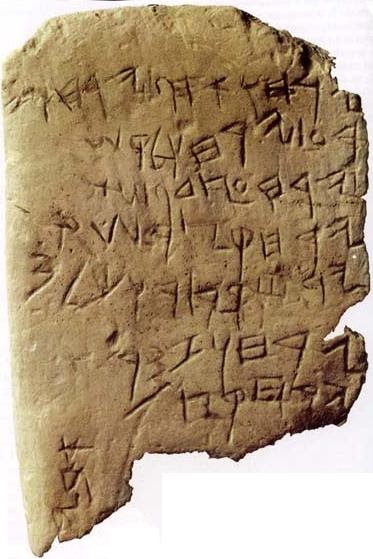
The Gezer Calendar
“The Gezer calendar is a small limestone tablet with an early Canaanite inscription discovered in 1908 by Irish archaeologist R. A. Stewart Macalister in the ancient city of Gezer, 20 miles west of Jerusalem. It is commonly dated to the 10th century BCE, although the excavation was not stratified.
Scholars are divided as to whether the language is Phoenician or Hebrew and whether the script is Phoenician (or Proto-Canaanite) or paleo-Hebrew. Koller argued that the language is Northern Hebrew.
The inscription is not a formal calendar, as it describes agricultural seasons with imprecise dates, rather than precise divisions of time as would be required for a ritual or bureaucratic calendar. As such, some of the time units comprise two months rather than one, and none are referred to by the month numbers or names known from other sources.
The calendar is inscribed on a limestone plaque and describes monthly or bi-monthly periods and attributes to each a duty such as harvest, planting, or tending specific crops.“
From Wikipedia, the free encyclopedia
The inscription, known as KAI 182, is in Phoenician or paleo-Hebrew script:
- 𐤉𐤓𐤇𐤅𐤀𐤎𐤐.𐤉𐤓𐤇𐤅𐤆
- 𐤓𐤏.𐤉𐤓𐤇𐤅𐤋𐤒𐤔
- 𐤉𐤓𐤇𐤏𐤑𐤃𐤐𐤔𐤕
- 𐤉𐤓𐤇𐤒𐤑𐤓𐤔𐤏𐤓𐤌
- 𐤉𐤓𐤇𐤒𐤑𐤓𐤅𐤊𐤋
- 𐤉𐤓𐤇𐤅𐤆𐤌𐤓
- 𐤉𐤓𐤇𐤒𐤑
- 𐤀𐤁𐤉(𐤄)
The text has been translated as:
- Two months gathering
- Two months planting
- Two months late sowing
- One month cutting flax
- One month reaping barley
- One month reaping and measuring grain
- Two months pruning
- One month summer fruit
- Abij[ah]
Connections to the Ancient Calendar
The Gezer Calendar and the ancient Canaanite calendar share some similarities. Both are agricultural in nature. While the Gezer calendar is focused on the planting and reaping of certain crops, the Canaanite calendar is centered around the seasons. In both calendars we also see a total of 12 months proving a common solar based system.
The addition of the name of Abijah at the bottom of the Tablet is a Mystery. Abijah in the Hebrew means Yahuah is my Father. Doubtfully a Canaanite saying…
Just Numbers
Now that we have the two calendars that we can trace back to scripture by the naming of the months, and a third tablet to confirm a solar 12-month connection dated to pre-exile times, we have a much more prominent method of reckoning the months and years in scripture to explore. With approximately 133 references to numbered months, the system of simply numbering the months is by far the default rule when it comes to the biblical calendar. While there aren’t any major revelations to be had here from a historical perspective, it’s important to recognize that the system of numbering spans the entire history of scripture, and it never appears to change in order or function. Also important to note is that there is no mention or reference anywhere to a 13th month. Some will try to imply it in places like Ezekiel and others, but they are really reaching. If we are truly honest and we stick to a simple reading of scriptures, armed with a little history we can conclude that at its origin, the biblical calendar consisted of 12 months and was most likely solar based in its structure and function.
 Torah is Light