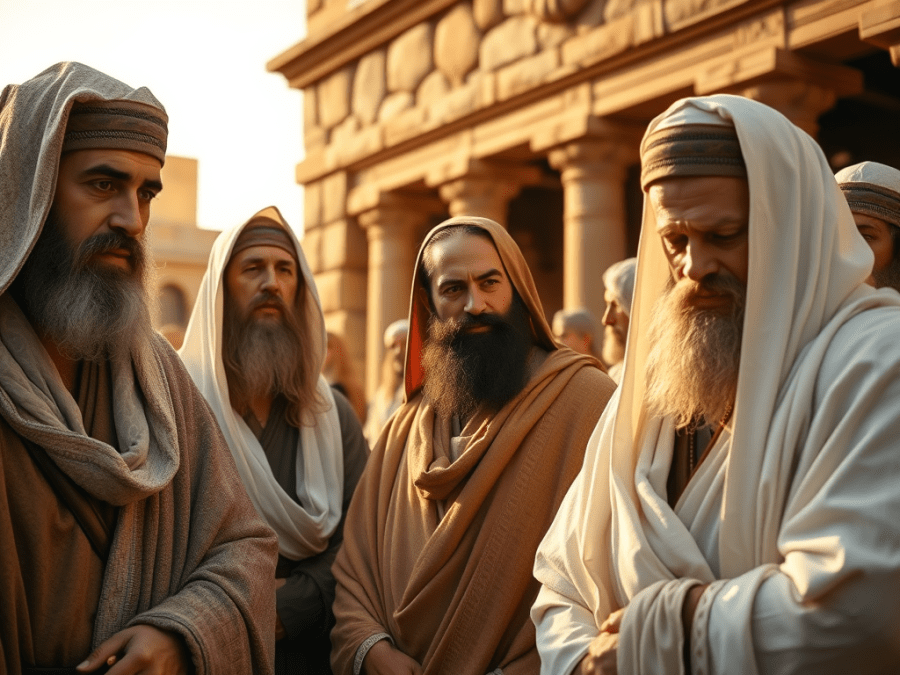
The calendars found in the Qumran scrolls were reckoned not only by months, but also by the rotation of the priestly courses also known as the mishmarot. The courses would come into the temple for service for one week starting on the Sabbath at the changing of the shew bread, then they would rotate out as the next group arrived to serve. The Qumran texts relied upon this ‘eternal cycle’ not only for their calendar, but also for their chronology and history. Every Sabbath, month, year and feast bore the name of a priestly family.
The priestly rotation required six years before the same group would be serving once again on the same week of the year. The order of the priestly courses was originally determined by lot, and is laid out in 1 Chr. 24:7-18 as follows:
- Jehoiarib – Yahuah will contend
- Jedaiah – Yah has known
- Harim – snub-nosed
- Se’orim – barley grains
- Malchijah – appointed by Yah
- Mijamin- from the right hand
- Haqqots – sense of pricking
- Abijah – father (worshipper) of Yah
- Jeshua – Yahuah saves
- Shecaniah – Yah has dwelt
- Eliashib – El will restore
- Jakim – he will raise
- Huppah – a canopy, chamber, closet, or defense
- Jeshebeab – seat of his father
- Bilgah – to cease
- Immer – talkative
- Hezir – to enclose or protect
- Happizzez – dissever; dispersive
- Pethahiah – Yah has opened
- Jehezekel – El will strengthen
- Jachin – he will establish
- Gamul – rewarded
- Delaiah – Yah has delivered
- Maaziah – Rescue of Yah
Who were the priests?
In scripture the duties of the high priest were given first to Aaron and then passed to his sons.
Exodus 27:21 In the tabernacle of the congregation without the veil, which is before the testimony, Aaron and his sons shall order it from evening to morning before the LORD: it shall be a statute forever unto their generations on the behalf of the children of Israel.
Later his eldest sons Nadab and Abihu offered strange fire and were killed so those duties then passed to his younger sons Eleazar and Itamar.
Leviticus 10:1 And Nadab and Abihu, the sons of Aaron, took either of them his censer, and put fire therein, and put incense thereon, and offered strange fire before the LORD, which he commanded them not.
We can trace the lineage in scripture with some gaps from Aaron to the time of Ezra. To fill in the gaps we have to rely on some additional resources such as Josephus and the Seder Olam. Both have some supporting and conflicting information so some discretion and research is required. Below is a fairly long list of high priests starting with Aaron and ending with Caiaphas. While it is a long list it is not exhaustive as there are still several gaps. However, it is worth the study because understanding what happened to these individuals especially leading up to the Maccabean revolt will help set the stage for a fundamental change in the power structure at the temple that ultimately results is a change of the calendar itself. At the end of the list, we will address a few other very important topics that will prove who truly had the authority over the temple and the calendar, and how we end up with some of the figures and groups mentioned in the Gospel writings. Having a solid understanding of who those groups and individuals are and what ultimately came from them could fundamentally change how you look at many of the traditions and teachings that have been for the most part blindly accepted by the messianic movement at large.
From Aaron to Caiaphas
The following list was compiled from scripture and data taken from https://en.wikipedia.org/wiki/List_of_high_priests_of_Israel#References
- Aaron, son of Levi and brother of Moshe
- Eleazar, son of Aaron
- Phinehas, son of Eleazar
- Abishua, son of Phinehas
- Bukki, son of Abishua
- Uzzi, son of Bukki
At some time, the office was transferred from the descendants of Eleazar to those of his brother Itamar.
- Eli, descendant of Ithamar, son of Aaron
- Ahitub, son of Phinehas and grandson of Eli
- Ahijah, son of Ahitub
- Ahimelech, son of Ahijah (or brother of Ahijah and son of Ahitub)
- Abiathar, son of Ahimelech – contemporary of King David and served alongside Zadok, 1 Chr 18:16
It is at this point in history that the Priestly courses were divided by King David and Zadok
1 Chronicles 24:3-4 And David distributed them, both Zadok of the sons of Eleazar, and Ahimelech of the sons of Ithamar, according to their offices in their service. And there were more chief men found of the sons of Eleazar than of the sons of Ithamar; and thus, were they divided. Among the sons of Eleazar there were sixteen chief men of the house of their fathers, and eight among the sons of Ithamar according to the house of their fathers.
Abiathar was later removed from the high priesthood for conspiring against King Solomon fulfilling the prophecy against the house of Eli. This reverted the lineage back to the descendants of Eleazar in 1Kings 2:27 and leads to the fulfillment of the promise made to Phinehas that from his line there would be an everlasting priesthood in Num 25:13, and the fulfillment of that is also foreshadowed in Ezekiel 40 with the sons of Zadok.
- Zadok – contemporary of King Solomon
- Ahimaaz – contemporary of King Rehoboam
- Azariah – contemporary of King Abijah
- Joash – contemporary of King Jehoshaphat
- Jehoiarib – contemporary of King Jehoram
- Jehoshaphat – contemporary of King Ahaziah
- Jehoiada – contemporary of King Jehoash
- Pediah – contemporary of King Jehoash
- Zedekiah – contemporary of King Amaziah
- Joel – contemporary of King Uzziah
- Jotham – contemporary of King Jotham
- Urijah – contemporary of King Ahaz
- Neria – contemporary of King Hezekiah
- Hoshaiah – contemporary of King Manasseh
- Shallum – contemporary of King Amon
- Hilkiah – contemporary of King Josiah and of King Jehoahaz
- Azariah IV – contemporary of King Jehoiakim
- Seraiah – contemporary of King Jeconiah and of King Zedekiah
After the Babylonian captivity
- Joshua, son of Jehozadak, after the building of the Second Temple. Contemporary of Cyrus the Great (reigned 538–530 BCE) and Darius I (reigned 522–486 BCE).
- Joiakim, son of Joshua (Nehemiah 12:10).
- Eliashib, son of Joiakim (Nehemiah 12:10). Mentioned in the time of Nehemiah in 444 BCE.
- Joiada, son of Eliashib (Nehemiah 12:10). (A son married a daughter of Sanballat the Horonite, for which he was driven out of the Temple by Nehemiah)
- Johanan, son of Joiada (Nehemiah 12:11). Mentioned in the Elephantine papyri in 410 BCE.
- Jaddua, son of Johanan (Nehemiah 12:11). Contemporary of Alexander the Great (reigned 336–323 BCE). Some have identified him as Simeon the Just.
- Onias I, son of Jaddua. Contemporary of Areus I of Sparta (reigned 309–265 BCE).
- Simon I, son of Onias. Josephus identified him as Simeon the Just and one of the last members of the Great Assembly
- Eleazar, son of Onias and brother of Simon I. Contemporary of Ptolemy II Philadelphus of Egypt (reigned 283–246 BCE).
- Manasseh, son of Jaddua, brother of Onias I and uncle of Simon I and Eleazar.
- Onias II, son of Simon I. Contemporary of Ptolemy III Euergetes of Egypt (reigned 246–221 BCE).
- Simon II, son of Onias II. Contemporary of Ptolemy IV Philopator of Egypt (221–204 BCE).
- Onias III, son of Simon II (?–175 BC), murdered 170 BCE
- Onias IV, son of Onias III, fled to Egypt and in c. 150 BCE built a Jewish Temple at Leontopolis (closed between 66–73 CE).
- Jason, son of Simon II, 175–172 BCE (the last of the Zadokite dynasty).
The Wicked Priest
Jason’s position as high priest came during a tumultuous time which is documented in 2 Maccabees. The new king of the Seleucid Empire Antiochus IV Epiphanes ruled Judea at the time and started to auction off the position of High Priest to the highest bidder. Onias III was dismissed from the High Priesthood and his younger brother Jason was given the role instead. It is not entirely clear why, but it is possible that Jason either offered a larger tribute to Antiochus, or since he was pro-Hellenization and sought to find compatibility between Judaism and Graeco-Roman thought that he was more willing to comply and pass rulings in favor of the Seleucid Empire.
From Commentary on Habakkuk (IQpHab)
Interpreted, this concerns the Wicked Priest who was called by the name of truth when he first arose. But when he ruled over Israel his heart became proud, and he forsook God and betrayed the precepts for the sake of riches.
While it is believed by some that the “wicked priest” mentioned in the Dead Sea Scrolls may be Jonathan Maccabeus he is never directly named. Jason, however, was known as being a moderate Hellenizer and it is likely that his actions of seizing the priesthood, along with his initial alliance with the Seleucid empire gained him the moniker of “the Wicked Priest“. Plus, he is the last in the line of Zadok being “called by the name of truth“. Additionally, Onias III later killed by Menelaus before the Maccabees took control, so Johnathan is honestly not a great fit. It is also worth mentioning that Jason also led a coup to reclaim his position from Menelaus which resulted in thousands being killed and thousands more enslaved. The city being attacked twice during that time and the decrees issued by Antiochus after Jason’s attempted coup are what led to the Maccabean revolt.
I could be wrong but the fact that Jason’s actions led to the temple being defiled, the city attacked, and the people killed and enslaved, he seems to fit the part as its described in the DSS. Additionally, his brother Onias III who he displaced was in exile during Jason tenure. This fact only helps to solidify the theory because it is also mentioned in the in Commentary on Habakkuk that the wicked priest “pursued the Teacher of Righteousness to the house of his exile that he might confuse him with his venomous fury“. All of this only exposes the struggle that no doubt took place between the brothers. And since Onias III was clearly anti Hellenistic and was described as a pious man, the contrast between him and his brother Jason are clearly seen; and depending on your view, the difference between wickedness and righteousness,
After this point in history the position of high priest never returned to the line of Zadok
- Menelaus, 172–165 BCE a Benjaminite
- Judas Maccabeus, son of Mattathias, 165–162 BCE a Hasemonean (held the office after the consecration of the Temple)
- Alcimus, 162–159 BCE
Hasmonean dynasty
- Jonathan Apphus, 153–143 BCE
- Simon Thassi, brother of Jonathan Apphus, 142–134 BCE
- John Hyrcanus I, son of Simeon Tassi, 134–104 BCE
- Aristobulus I, son of John Hyrcanus, 104–103 BCE
- Alexander Jannaeus, son of John Hyrcanus, 103–76 BCE
- John Hyrcanus II, son of Alexander Jannaeus, 76–66 BCE
- Aristobulus II, son of Alexander Jannaeus, 66–63 BCE
- Hyrcanus II (restored), 63–40 BCE
- Antigonus, son of Aristobulus II, 40–37 BCE
- Herodian-Roman period
- Ananelus, 37–36 BCE
- Aristobulus III, grandson of Aristobulus II and Hyrcanus II, 36 BCE (He was the last of the Hasmoneans; brother of Herod’s second wife Mariamne I)
- Ananelus (restored), 36–30 BCE
- Joshua ben Fabus, 30–23 BCE
- Simon ben Boethus, 23–5 BCE (his daughter Mariamne II was the third wife of Herod the Great)
- Matthias ben Theophilus, 5-4 BCE[16]
- Joazar ben Boethus, 4 BCE
- Eleazar ben Boethus, 4–3 BCE
- Joshua ben Sie, 3 BCE – ?
- Joazar ben Boethus (restored), ? – 6 CE
- Ananus ben Seth, 6–15
- Ishmael ben Fabus (Phiabi), 15–16
- Eleazar ben Ananus, 16–17
- Simon ben Camithus, 17–18
- Joseph ben Caiaphas, 18–36 (son-in-law of the high priest Ananus ben Seth)
This brings us to the time of John and our Messiah Yahusuah.
Luke 3:1-2 Now in the fifteenth year of the reign of Tiberius Caesar, Pontius Pilate being governor of Judaea, and Herod being tetrarch of Galilee, and his brother Philip tetrarch of Ituraea and of the region of Trachonitis, and Lysanias the tetrarch of Abilene, (2) Annas and Caiaphas being the high priests, the word of God came unto John the son of Zacharias in the wilderness.
John 18:13 And led him away to Annas first; for he was father-in-law to Caiaphas, which was the high priest that same year
The Pharisees and Sadducees
When we open our bibles and start reading the Gospels there are two groups that stand out, the Pharisees and the Sadducees. There have been a lot of claims made as to who these groups were and what their role was in the temple, but there really isn’t much offered in mainstream Christian teachings about who they really were. Understanding who these group are, their history, and connections to the temple, will help us to understand their authority and position and the significance of Yahusha’s words concerning them when we encounter them in the gospel accounts.
The Sadducees
The Sadducees get their name from the Hebrew word צְדוּקִים, (Zadokites). The name Zadok is related to the root צָדַק, (ṣāḏaq) which means to be right or just. It is by no mistake that the group adopted the name. While they have no real connection to the Zadok Priestly line, adopting the name gives them the appearance of having that connection and authority. Truth is that their founder was a pupil of Antigonus of Sokho during the first half of the 3rd century BCE. Antigonus had two pupils named Zadok and Boethus. Zadok founded the Sadducees and Boethus founded the Boethusians, but the two groups remained very closely related in their practice and could be seen as being synonymous with one another. Both groups rejected the Oral Torah as proposed by the Pharisees. Rather, they saw the Written Torah as the sole source of divine authority even rejecting the writings and the prophets. According to Josephus, the Sadducees beliefs included:
- It is a virtue to debate and dispute with philosophy teachers.
- Rejection of the idea of fate or a pre-ordained future.
- God does not commit or even think evil.
- Man has free will; “man has the free choice of good or evil”.
- The soul is not immortal and there is no afterlife, and no rewards or penalties after death.
Additionally, they used their denial of an afterlife or resurrection as an excuse to live in luxury because without an afterlife they would have nothing to show for it in the world to come, as a result they chose to indulge while they could and often used gold and silver when others would use earthen vessels. It is not surprising that the sects found most of their followers among the wealthy.
The Boethusians are believed to have been associated with several members of the high-priestly family of Boethus which began their tenure when Simon, son of Boethus from Alexandria, was made a high priest about 25 BCE by Herod the Great, in order that his marriage with Boethus’s daughter, Mariamne would be seen a legitimate because Boethus was of a lower social class. With the appointment of the Sadducees/Boethusians to the high priest position they gained control of the temple and oversaw many of the formal affairs of Israel. Those duties included some but were not limited to the following tasks:
- Administered the state domestically
- Represented the state internationally
- Participated in the Sanhedrin, (basically their version of a supreme court).
- Collected taxes. These also came in the form of international tribute from Jews in the Diaspora.
- Equipped and led the army
- Regulated relations with the Roman Empire
- Mediated domestic grievances
After the destruction of the Temple in 70 CE the Sadducees pretty much disappeared from history and ceased to have any substantial influence over mainstream Judaism. However, it is believed that they could have had a part in the formation of Karaite Judaism which is a small non-rabbinical sect that still exists to this day.
The Pharisees
Coming soon…
The Rightful High Priest
Coming soon…
The 24 Elders
24 appears to be a very significant number. Understanding that the earthly Tabernacle, its artifacts and the order of service are all patterned after the true Tabernacle in Heaven as was shown to Moshe when he was atop the Mount Sinai may help us understand the priestly courses as well. If that pattern holds true, (which I have no reason to doubt that it would), then the mystery of who the 24 elders mentioned in Revelation chapter 4 can be solved.
Are they the “church” leaders as some suppose? No… Are they saints that were elevated to a high position? No… What about the disciples? Nope…
These elders as they are called appear to have been in service of the Temple since the time of creation or even before. They are not earthly beings, but rather heavenly, and the priestly order that was laid out in 2 Chronicles by David and the high priest Zadok was simply a shadow of the pattern that they set forth.
Understanding the Priestly courses is a vital part of unlocking the mystery of the scrolls.
What to Read Next: Calendars Ancient and Modern
The Technical Stuff
Below is a link to a chart of the priestly courses and how they fall according to the Dead Sea Scrolls
In the calendar documents of the Dead Sea Scrolls there is a portion 4Q319 that talks about the Jubilee signs or conjunctions. This data can be confusing at first until it is charted out. Having a general understanding of how the priestly courses work is very important at this point, otherwise none of the information contained in those fragments will make any sense.
There is an anomaly that happens at the end of the 3rd Jubilee where the order of Shecaniah is mentioned rather than Mijamin who was the priestly order that headed up the beginning of the 4th Jubilee cycle. From what I can gather scholars have determined this to be a scribal error. However, I think I figured out the supposed “error” is. When the author states that the “sign of Shecaniah which is the sign of the end of the third jubilee” I don’t think that it’s an error at all. I think it is exactly what he says it is. We (or I) just assumed that that they meant that Shecaniah would have begun the next cycle when it is clear that Mijamin does. However, if the Jubilees are the first year of the following cycle, then Shecaniah does in fact mark the END of the third jubilee because he serves at the beginning of the 2nd year and half his week would be in the previous year which would be the end of the 3rd Jubilee, so there is no mistake, just a misunderstanding with the interpretation of the Scrolls.
It appears that they were not necessarily consistent regarding whether the “sign” was at the beginning or at the end of the jubilee just that it was a marker. And other than the single mention of Jeshebeab in relation to the jubilee they seem to stick to either Gamul or Shecaniah which I think generates the confusion. If we go off this reasoning then everything lines up and the count of the signs also fits as they didn’t count any priestly lines other than Gamul or Shecaniah, nor did they count the signs of the previous cycle in with the next, with exception to the 3rd jubilee, which is where the confusion started. Why they chose to say it that way rather than just saying “Gamul in the 6th year” is beyond me but either way it’s definitely not in error.
I know this isn’t earth shattering news. Just thought it might add some clarity if anybody ever has to explain that to someone who questions the priestly order and how it functions. People will find anything they can to discredit things they don’t believe so if we can clearly explain these “issues” then it takes away the doubt.
Below is a link to what I have compiled from the fragments of 4Q319 and Mishmarot F (4Q328) which delineates the year into its respective seasons according to the priestly orders and clearly shows the courses and how the “signs” fall.
I have also gone through and done some research to establish sabbatical years, and even the timing of the birth of our Messiah. By overlaying this data given through various resources and by scripture with the priestly courses we can with some level of confidence establish where we are in the timeline of history. This is important for several reasons. If we desire to be obedient to the commands of Yahuah, then we should also seek to observe His land Sabbaths and Jubilees. Without knowing where we are in the pattern, we have no way of knowing if we should tend our gardens or not. I know that we are not all in the Kingdom yet, but this doesn’t mean that we should just ignore these basic commands to trust our Heavenly Father with not just our salvation but with our provision of food as well.
This also has other prophetic significance as well. The nominal church preaches an imminent secret rapture (a doctrine that is never found in scripture by the way). They say that nobody will know when it will happen because He will come as a thief in the night quoting 1 Thess 5:2.
What they fail to read is just 2 verses later where it states:
1 Thessalonians 5:4-6 But ye, brethren, are not in darkness, that that day should overtake you as a thief. Ye are all children of light, and the children of the day: we are not of the night, nor of darkness. Therefore, let us not sleep, as do other; but let us watch and be sober.
It is interesting to note that the term “children of light” is found all throughout the Dead Sea Scrolls in reference to those who follow the ways of Yahuah.
I say all this to say that I believe that we can know general the timing of Messiah’s return. Maybe not the exact day or hour as scripture makes abundantly clear. However, based upon the events that are happening around us, the fulfillment of prophecy, and the general timelines that we are given, I believe it’s possible to establish a general window that we should be paying very close attention to. I will not get into date setting or making claims that I know when the end is, because I simply do not. But what I can tell with a high level of confidence is that our time is indeed very short. Nevertheless, we are to be continually waiting and watching, being sober and vigilant so that we are not overtaken as the rest of the world will be while they say “peace and safety”
Below is a link to the data that I have overlaid with the priestly courses showing my theory as to the timing of the birth of our Messiah and the days in which we live.
I go into more detail explaining the information in this document on my page The Birth of our Messiah
 Torah is Light
Pingback: 14 Insane Theories About the Dead Sea Scrolls (That Scholars Don't Want to Talk About) - Back in Time Today
Pingback: 19. The Prophetic Mystery of Messiah – MESSIAH NOW